
Time to read: 5 minutes
In this newsletter, you will find one topic:
- What we fear and what we control...
- What does AI do? What do YOU do?
- Your AI readiness survey
What we fear and what we control...
Hi {{first_name | default: 'there'}},
I hope the sun is finding you this May 1st weekend. Since Labour Day exists to celebrate the right to rest, it feels wrong to take up too much of your time today, so I will keep this one a little shorter than usual.
However, there is something that keeps me thinking these days.
When I ask people what AI's biggest opportunity is, they all say efficiency. Save time, delegate the routine, focus on the creative. When I ask what they fear most, they say becoming obsolete.
I asked both questions at some events recently. Among others on a formal evening with a big group of business school alumni in Austria, where I held an interactive talk on leadership in the AI age. Also, during an informal gathering of professionals held in Zürich where I was one of the panelists.
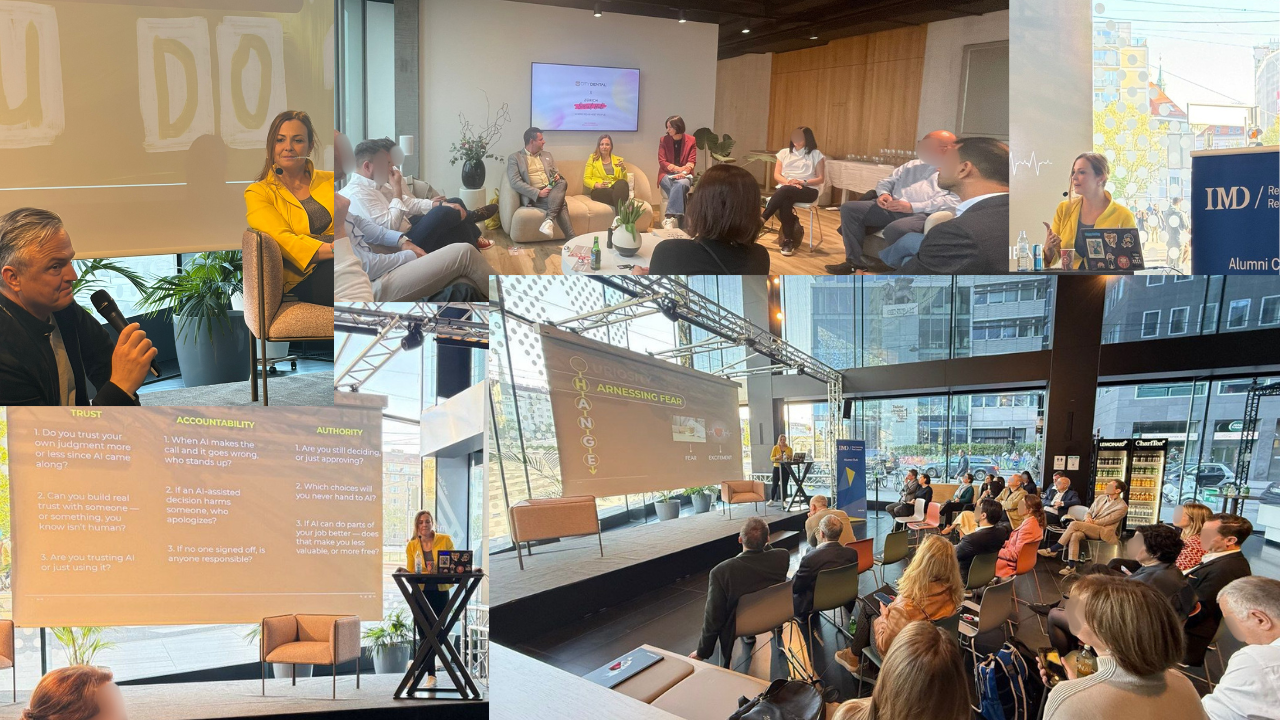
Different rooms in different countries, very similar conversations
The answers were almost identical across the different rooms. The opportunity side was practical, sensible, aligned.
The fear side got personal fast. Becoming obsolete. Getting lazy and stopping to think for yourself (!). One person said "FOMO, am I doing the right moves with AI as an entrepreneur." Another one: "human mankind getting more and more stupid." Both honest. Both a little funny in a not-entirely-funny way.
I also asked how much influence people feel they have to make AI adoption more human. Most said "some." A few said "no influence" or "very little." Only a handful said significant or a great deal. These are experienced leaders with real organizational weight, and most of them feel like passengers on this particular train.
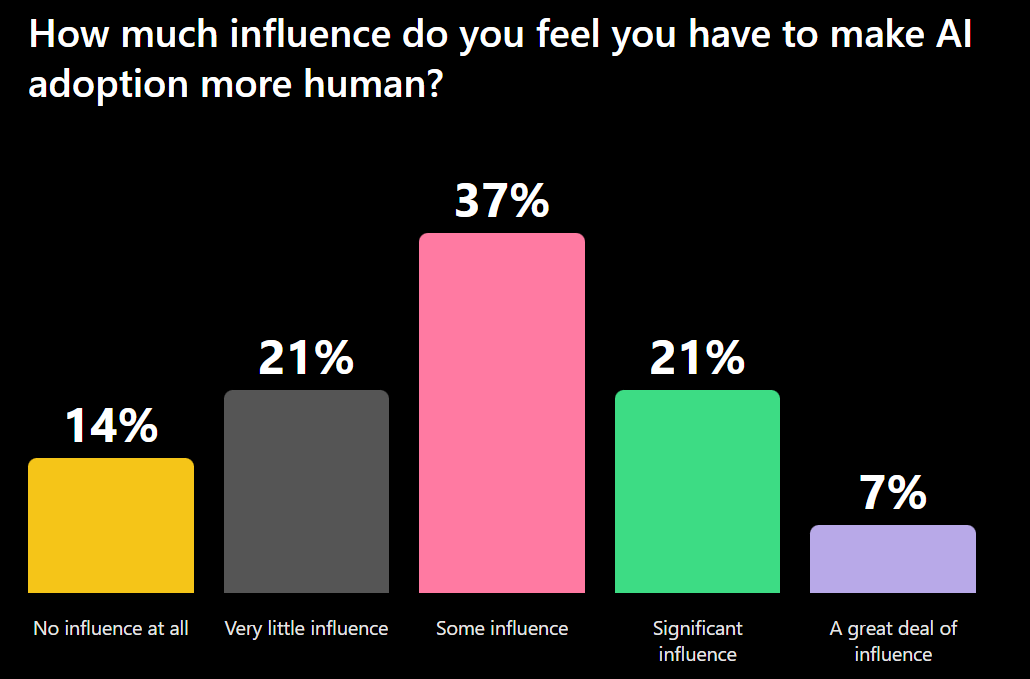
Source: Own pulse survey across professional events around AI & Leadership, Jan-May 2026
That stayed with me more than the fear answers did. Because if you believe the upside is real and the downside is real, but you also believe you have no influence on which one shows up, you are essentially waiting to find out what happens to you.
That is a strange place for a leader to sit. And it is, I think, where a lot of us actually are right now, even the ones who would never say so out loud.
And the very reason I do these talks at many corporate and community events is to change that. To give you back human agency.
What does AI do? What do YOU do?
Since we are afraid of losing the ability to think, I challenged the crowd and suggested them to leverage AI by improving their thinking.
During these events, I asked everyone to open their AI tool and send it a specific prompt about a thinking mistake they had been repeating.
Try it for yourself below👇🏻:
---------START of the prompt
Based on everything you know about me from all the conversations we had so far, identify one significant mistake I made in the past year, not operationally, but in how I thought, decided, or avoided something.
Describe the pattern behind it, what it may have protected me from at the time, and what it might be costing me now. Be specific, don’t hallucinate.
-------- END of the prompt
People got back things they recognized. Specific, accurate, occasionally uncomfortable.
"You wait until a situation is urgent enough that you no longer have a real choice"
"You assume that if people understand your argument well enough, they will get behind it.”
"You keep preparing for a moment you are already ready for."
I could relate to many of them…
Someone said plainly: knowledge costs nothing now. Any research, any framework, any expertise you spent years building is available to anyone in ten seconds.
Someone else followed: if everyone has access to the same knowledge, what makes your output different from mine? And then we sat with what that actually means for people whose professional identity is built around knowing things.
If the routine gets delegated and knowledge is free, what is left that is specifically yours?
Not a list of soft skills. Something more concrete.
Judgment applied to your particular situation, with your organization's history and the people involved, which no prompt can fully describe.
A perspective built from your actual experience, the failures included, not a synthesis of what everyone else already said.
And the thing that happens when you are physically in a room with someone and something changes because of who you are, not what you looked up.
I believe the question worth asking right now is not whether AI will take your job. It is whether you are building and leaning into your human differentiator, or just assuming they will survive whatever you delegate away.
Skills that are not practiced do not hold. Neither does judgment.
If the tool knows you well, the answer will be more useful than most strategy sessions. If it barely knows you, that is also information worth having. Either way you will leave the exercise with something you did not have ten minutes earlier, which is a clearer picture of where your real value sits and where you are coasting on habit.
If you want to go a level deeper, there is a free AI readiness assessment on our website that is worth a few minutes of your time. It asks the questions that come before the strategy. You can find it here:
I want to take the AI readiness survey
And if the assessment, or something in this newsletter, makes you want to think through your specific situation with someone, hit reply and we can talk about your next steps.
Did you miss our last newsletters?
Inboxes can get a little crazy, right? Just in case you missed them, here are the links to our previous newsletters:
- Newsletter #31: I’m sharing how to tell if you’re on the right flight in the AI era, why most leaders sit in a hidden “judgment gap,” and the one prompt that forces real clarity. → LINK HERE
- Newsletter #30: I’m sharing how bad coaching isn’t about you—it’s about connection, why context beats technique, and what real leadership looks like in the AI age. → LINK HERE
- Newsletter #29: I’m sharing how asking AI for a mirror reveals your blind spots, why thinking is becoming cheap, and how to define your value in the AI age. → LINK HERE
Thanks for reading. Just drop a quick reply if you have any feedback.
Wishing you a great weekend ahead.
Until next time,
Tap the buttons to stay connected!



How can we work together?
-
You have rolled out Copilot. Your teams have gone through hundreds of training sessions. But in their daily work? Nothing's really changed. I help leaders bridge that gap: turning AI adoption from a checkbox exercise into measurable results your teams actually use. Let's talk.
- Hire me as your executive coach to help you master change. Sign up for a 30-min complimentary coaching call (waitlist applies).
- Book me as a speaker, panelist or moderator for your event. Get some impressions on how it is, here. Or watch my TEDx talk here.

Responses